
Some years ago, while attending a conference, I chatted with a fellow pastor from Canada. After we chatted awhile he mentioned he was having a little trouble because his sinuses were acting up. As I offered some usual pastoral responses he went on to explain that he was allergic to most perfumes, colognes, etc. He was bemoaning the fact that he was not back home because where he lived in Canada they had ‘scent free zones.’ Even some elevators and busses were scent free. Having never heard of such a thing I was stunned. He explained that Canadian law had stepped up to protect those with his type of allergies. While you and I might think no scents makes no sense, to him – and I’m sure to many others – it was a blessing.
The next day, another pastor who had been part of that conversation chatted with me again. She and I were expressing sympathy for people with such allergies but also amazement that the law could actually go as far as to ban scents. We bantered back and forth, tongue in cheek. “On the one hand the law was protecting some from danger but it was also restricting others in their freedoms.” “I mean, isn’t there some medication for such allergies?” “Why penalize us who are healthy?” We wondered where such laws might end if all allergies led to prohibitive laws. It’s a difficult balance. As I thought about those conversations a principle came to mind: “When you come to a scent-free zone, use your scents.”
I got my clue from the apostle Paul. He wrote “But thank God! He has made us his captives and continues to lead us along in Christ’s triumphal procession. Now he uses us to spread the knowledge of Christ everywhere, like a sweet perfume. Our lives are a Christ-like fragrance rising up to God. But this fragrance is perceived differently by those who are being saved and by those who are perishing. To those who are perishing, we are a dreadful smell of death and doom. But to those who are being saved, we are a life-giving perfume.” (2 Corinthians 2:14-16 New Living Translation)
Paul knew that Christians have an odor. Some are allergic to it – for them it is the aroma of death.

Some are drawn to the aroma – for them it is new life.

But for Paul there was no difficult balance – he urged us to spread the scent. This is especially true when we are among people, or in places where there is no Christly aroma – a scent free zone. “When you come to a scent-free zone, use your scents.” It’s the only thing that makes sense. Whereas people do not choose their physical allergies, reaction to the scent of Christ is a personal choice. People must smell Jesus so they can have a choice of life or death. They must smell the aroma. So “When you come to a scent-free zone, use your scents.” Each person who picks up your scent will determine whether or not they have a deadly allergy.
Well, it’s brief but that’s my two cents worth. I hope it makes sense. “When you come to a scent-free zone, use your scents.”

 fire, a world of evil among the parts of the body. It corrupts the whole person, sets the whole course of his life on fire, and is itself set on fire by hell.” Have you ever been burned by the tongue of someone who, with a few choice words, cut us to the quick? How many of us as parents have not, at some point in time, said something that burned and harmed our children? The tongue, like fire, does lasting damage.
 caused more hurt than laughter? And what about the name-calling you did in jest? Or the gossip you passed along? How have you spoken to or about your mate, children, parents, coworkers, and leaders?
 It’s often been said that the most segregated time in America is Sunday morning. There is some truth to that, in that many congregations are not multi-racial or cross cultural. While I’m not trying to downplay the situation, I do believe that part of the reason has more to do with preferred worship and preferred cultural styles than with intentionally blocking out persons of other cultures and races. That’s why, in addition to worship segregation between cultures there is segregation within cultures as well.
 I established
  him Pete. Pete fell into a hole. The walls are so steep he cannot get out. Pete hears someone walking by and hollers up “Can you help me out?” The walker was a doctor so he wrote out a prescription, threw it into the hole, and moves on. Hearing another person walk by Pete shouts up “I’m down in this hole. Can you help me out?” The walker was a pastor so he writes out a prayer, throws it into the hole, and moves on. Pete hears another person walking by and hollers up again. This walker is a friend of the man so he jumps into the hole to be with him. Pete exclaims, “Are you stupid? Now we’re both in the hole!” His friend replies, “Yeah, but I’ve been down here before, and I know the way out.” Jesus is the Priest for us and for God; He’s been in our holes and knows the way out. He not only understands, but he can help.
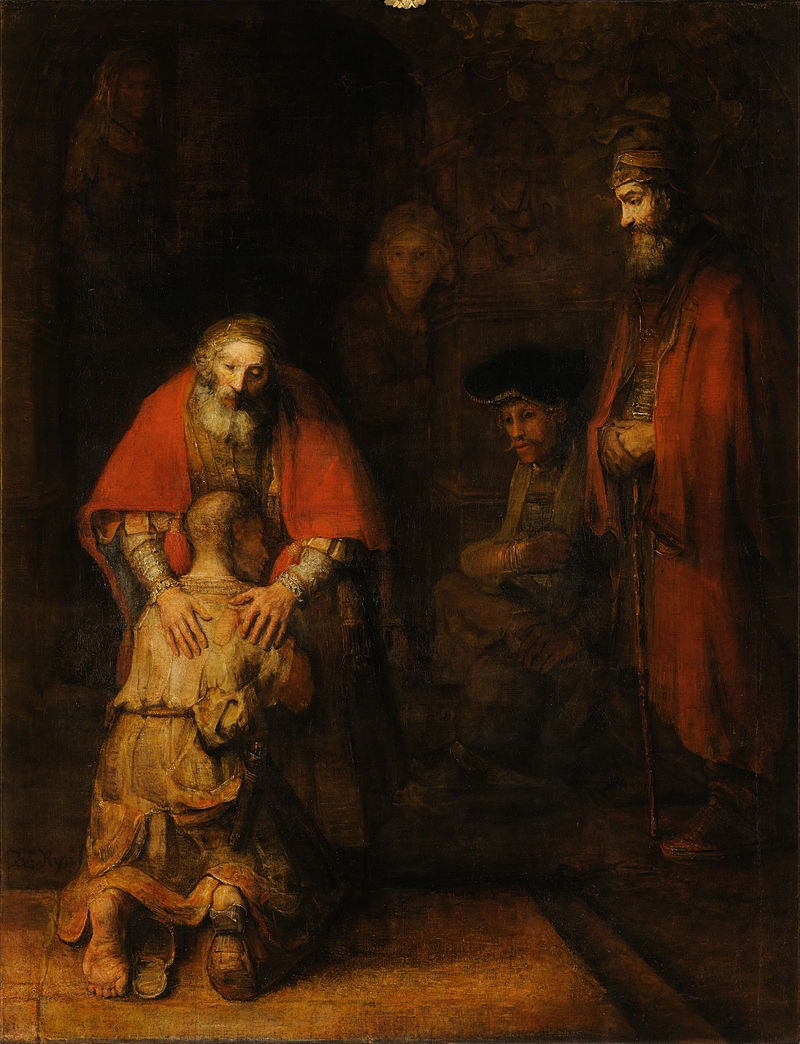 He then wasted it all on lavish, foolish, sinful living. When he finally realized the error of his ways he returned home to his father – who raced out to greet him with open arms, and threw a feast to celebrate his return. Because of Jesus, we can always return to our Father.
 God’s grace is complete and full! This is not the great white throne of judgment – this is a throne of grace! God’s sovereign power and dominion are rooted in love and grace. Our Divine Aid is rooted in love and grace. From the throne we will receive loving favor, even if we are utterly undeserving. The King of Kings and Lord of Lords has a grace-filled heart! To dial the throne is to tap into grace!
 (as well as the attention of many others!) She responded to a video of fired Trump staffer Omarosa Manigault Newman saying “Everybody who’s wishing for impeachment might want to reconsider. We would be begging for days of Trump back if [Vice President Mike] Pence became president… He’s scary.” Newman, said, “I’m a Christian. I love Jesus, but he thinks Jesus tells him to say things.” Behar quickly chimed in with her view. “It’s one thing to talk to Jesus. It’s another thing when Jesus talks to you. That’s called mental illness — if I’m not correct — hearing voices.”

 I was intrigued, although not surprised by a news item coming from the Olympics. One of our American athletes was upset that he did not get selected to carry the American flag during the opening ceremonies. He was upset with the selection process. Perhaps he should have been selected. Perhaps the selection process is flawed. I have no way of knowing these things. But I do understand the emotion that prompted his public comments and that is why I was not surprised.
 and honor their countries. But the reality is that for most athletes it’s a time to win and be honored. I’m not saying that’s bad or wrong. Rather my issue is that we all too easily equate honor with winning, with being selected to hold the flag. Honor is equated with being the top dog, the most popular, or the most respected. Honor goes to the one who hangs out with or is seated by people of influence. I understand because I’ve too often been there and believed that.

 earthly days He was hanging on a cross, condemned to die as a criminal but chosen to die for the sin of the world. His final words, at the end of the day, were “Father, into your hands I commit my Spirit.” What’s significant is that these words are from Psalm 31 – they were not new; they formed a familiar prayer for the Israelites. Beginning at an early age these words were uttered by the children at bedtime as they placed themselves in unshakeable trust in the hands of the Father. They are really very similar to the spirit of our “Now I lay me down to sleep, I pray the Lord my soul to keep. If Jesus comes before I wake I pray the Lord my soul to take” (or some variance thereof).

 with Jesus. In doing so He has brought us into His family. What’s amazing is that Paul is referring to the Corinthian church. If ever a church was far short of what it ought to be, this was it. Immorality was rampant, a code of ethics was all but non-existent, and her theology was badly tainted. Yet, says Paul, her members are sanctified – they are saints. And so are we! Because of Christmas we have been given the position of being children of God – brothers and sisters of Jesus Christ! At our baptisms, God put his mark, his seal, his brand upon us. He gave us the same royal status as that of His Son!
 substance. An apple has a core. Plums and peaches have pits. But an onion is merely the sum total of its layers. It is so easy for us to simply become the sum total of what others expect or want us to be. There’s a layer for the boss, one for the spouse, one for the children, one for the coach, one for the church. Soon we lose track of our identity. Never forget who you are! You are a brother, a sister, of Jesus Christ. You are a saint!
 passage on the first steamer leaving Rotterdam, settling for accommodations in steerage rather than waiting for another six months to travel in the grand style that her relatives had planned for her. A thoughtful purser, familiar with this common choice among families anxious for reunions, discreetly offered the hospitality of the upper decks of the ship during the day. Greta declined this privilege, however, and remained sequestered in her dark, rancid, and noisy quarters for the fourteen long days of her journey. My aunt called this ‘minding one’s place.’ She never presumed that there was anything more to sailing across the menacing Atlantic Ocean than enduring volcanic tosses from her mildewed perch until reaching land safely on the other side. Only on disembarking in New York Harbor did Greta behold what she had been missing. On those upper decks that she had regarded as off limits were tapestries, chandeliers, wood-carved cornices, oriental rugs, silver, gleaming crystal, and buffets laden with exotic and plentiful food and drink. Most alarming of all, though, there were people just like Aunt Greta, stranded in fourth-class sleeping accommodations, who had accepted the invitation of the venerable steamship company and had toddled above to enjoy the treasures daily. ‘Imagine,’ my aunt would gasp. ‘It could all have been mine, too, had I only said yes.”
 streets – they were preparing to watch the circus parade into town. So the boy joined the crowd and this was the grandest thing he’d ever seen. Caged animals snarled, bands played loudly, midgets performed acrobatics, and the clowns brought up the rear. As one of the clowns passed by the little boy reached into his pocket, took out his dollar bill, and handed it to the clown. With that he turned and went home. As far as he knew, he had seen all there was to see of the circus – but he had only seen the parade. Things are not always what they seem!